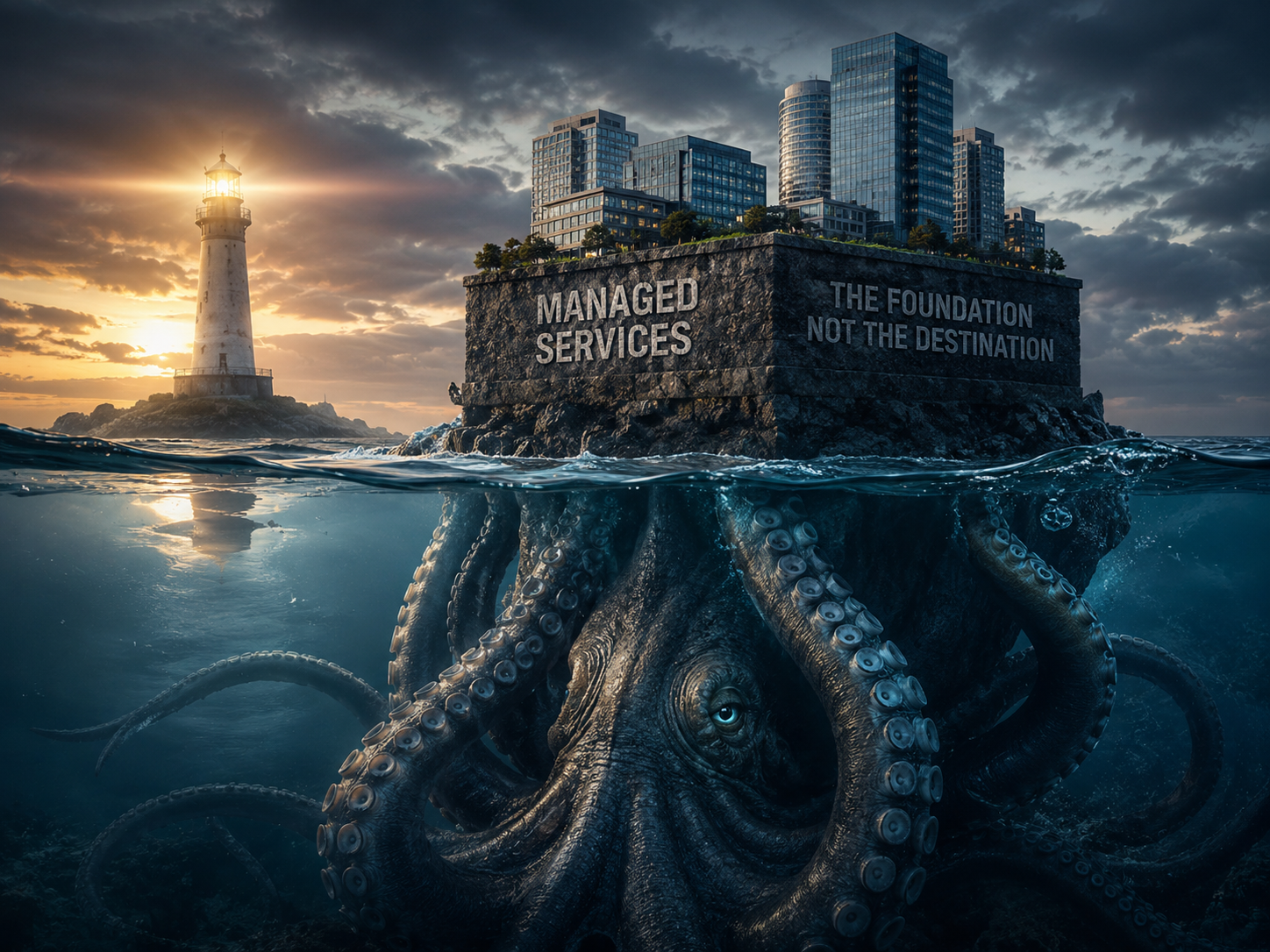
Why the Future of Managed IT Services Is About Building Better Organizations, Not Just Better Technology
For more than two decades, Managed IT Services have transformed how businesses approach technology. Instead of waiting for computers to fail, organizations embraced proactive monitoring, cybersecurity, cloud services, and strategic IT planning.
That evolution was important.
In fact, it remains one of the smartest investments a growing business can make.
But as technology, cybersecurity, artificial intelligence, and governance continue to evolve, an important question emerges:
Is simply managing technology enough to help a business succeed over the next decade?
At Kraken Technology Solutions, we believe the answer is no.
Managed Services aren’t becoming less important.
They’re becoming more foundational.
The difference is understanding that Managed IT Services are the platform upon which modern organizations build resilience, growth, governance, AI readiness, and long-term enterprise value.
The Evolution of Managed IT Services
Years ago, businesses hired an IT company because they needed someone to fix computers.
Then the industry evolved.
Managed Service Providers (MSPs) introduced proactive support:
- Remote Monitoring & Management
- Help Desk Services
- Patch Management
- Microsoft 365 Administration
- Endpoint Security
- Backup & Disaster Recovery
- Network Management
- Vendor Management
This dramatically improved business operations.
Instead of reacting to failures, organizations became proactive.
That shift alone saved businesses millions of dollars in downtime and lost productivity.
Today, those services remain absolutely essential.
But they’re no longer the finish line.
Technology Has Become the Operating System of Modern Business
Think about your business for a moment.
Technology now touches nearly every function:
- Sales
- Marketing
- Accounting
- Human Resources
- Customer Service
- Operations
- Finance
- Manufacturing
- Compliance
- Executive Decision Making
Technology isn’t simply another department.
It’s woven into every aspect of how organizations operate.
That changes the role of Managed IT.
Instead of asking:
“Can our IT provider support our computers?”
Business leaders should be asking:
“Can our technology help us build a stronger company?”
That’s an entirely different conversation.
The Foundation Makes Everything Else Possible
A house cannot be built without a strong foundation.
The same is true for modern organizations.
Managed Services provide the stability every business needs:
- Reliable infrastructure
- Standardized systems
- Cybersecurity protections
- Device management
- Microsoft 365 administration
- User support
- Backup and disaster recovery
- Identity management
Without these capabilities, businesses remain reactive.
But once this foundation is established…
Something much bigger becomes possible.
What Comes After Managed Services?
This is where many organizations miss tremendous opportunities.
Once technology is stable, leaders can begin asking higher-level questions.
Strategic Technology Leadership
Technology decisions should no longer be made after business decisions.
They should help shape them.
Technology leadership helps organizations answer questions like:
- How can technology accelerate growth?
- Which investments create the greatest business value?
- Where can automation improve efficiency?
- How should AI fit into our long-term strategy?
- What technologies should we avoid?
Technology becomes a strategic business capability—not simply operational support.
Cybersecurity Protects More Than Computers
Modern cybersecurity isn’t simply about antivirus software.
It’s about protecting:
- Customer trust
- Brand reputation
- Business continuity
- Intellectual property
- Financial stability
Cybersecurity has become a leadership responsibility.
Every strategic initiative—from AI adoption to acquisitions—must consider cyber risk.
Managed Services establish the security foundation that allows organizations to grow confidently.
Governance Creates Organizational Maturity
Many businesses operate successfully despite lacking formal governance.
As they grow, that eventually changes.
Questions begin to emerge:
- Who owns organizational knowledge?
- How are decisions documented?
- Who approves AI usage?
- How is sensitive information protected?
- What happens when key employees leave?
Technology governance helps organizations answer those questions before they become problems.
It creates consistency.
It creates accountability.
Most importantly, it creates resilience.
AI Doesn’t Fix Broken Organizations
Artificial Intelligence has become one of the most discussed business topics in recent years.
Many organizations are racing to implement Microsoft Copilot, ChatGPT, and other AI tools.
But AI has a hidden dependency.
It requires organized, trusted, governed information.
If your business has:
- Files scattered everywhere
- Tribal knowledge
- Poor documentation
- Inconsistent processes
- Duplicate information
AI simply learns from chaos.
Organizations that intentionally organize knowledge, implement governance, and build strong operational foundations will gain significantly more value from AI than organizations that skip those steps.
AI readiness begins long before the first AI license is purchased.
Organizational Knowledge Is a Competitive Advantage
One of the greatest risks facing growing organizations isn’t technology.
It’s losing institutional knowledge.
When knowledge lives only inside employees’ heads, organizations become fragile.
Modern businesses should be building:
- Centralized documentation
- Standard operating procedures
- Knowledge libraries
- Executive dashboards
- KPI reporting
- Process documentation
Not because documentation is exciting.
Because organizations become dramatically more resilient when knowledge belongs to the business—not individuals.
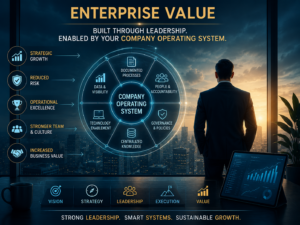
Building Enterprise Value
Business owners often think about technology as an operating expense.
We believe it should also be viewed as an investment in enterprise value.
Organizations that intentionally mature their operations often experience benefits such as:
- Faster onboarding
- Improved operational efficiency
- Better executive visibility
- Reduced key-person risk
- Stronger cybersecurity posture
- Improved compliance readiness
- Better decision-making
- Greater scalability
These improvements don’t automatically increase a company’s valuation, but they can strengthen the capabilities and operational maturity that buyers, investors, lenders, and leadership teams often value.
Technology becomes part of building a stronger business—not just maintaining one.
Managed Services Are the Beginning
Managed IT Services remain one of the most valuable investments an organization can make.
Reliable support.
Secure infrastructure.
Standardized technology.
Responsive service.
Those capabilities are essential.
But they should be viewed as the beginning of the journey—not the destination.
Once the foundation is established, organizations can begin building:
- Strategic Technology Leadership
- Cybersecurity Maturity
- Governance
- Compliance
- AI Readiness
- Knowledge Management
- Executive Reporting
- Organizational Operating Systems
That’s where businesses begin creating long-term competitive advantage.
The Future of Managed Services
The future of Managed Services isn’t simply adding more software tools.
It’s helping organizations become:
- More resilient.
- More efficient.
- More secure.
- More intelligent.
- More valuable.
Technology should no longer be viewed as something that simply keeps the lights on.
It should become one of the most powerful strategic assets within the organization.
At Kraken Technology Solutions, that’s exactly how we think about Managed Services.
Not as the destination.
But as the foundation that enables organizations to build secure, governed, AI-ready, technology-enabled businesses capable of thriving over the next decade.
Final Thoughts
Business leaders don’t wake up hoping to buy another security product or another software subscription.
They wake up asking:
- How do we grow without creating chaos?
- How do we build a business that scales?
- How do we protect what we’ve built?
- How do we prepare for the future?
Those are leadership questions.
Technology, cybersecurity, governance, compliance, and AI should all contribute to answering them.
Managed Services make those conversations possible.
And that’s why we believe Managed Services are not the destination—they’re the foundation.
Ready to Build More Than Just an IT Strategy?
Technology has never been more important to the success of your organization—but simply keeping systems running isn’t enough.
If you’re wondering:
- Is our technology helping us achieve our business goals?
- Are we prepared for AI over the next decade?
- Is our cybersecurity strategy aligned with our growth plans?
- Are we building institutional knowledge or relying on tribal knowledge?
- Is our technology increasing the long-term value of our business?
…then it’s time for a different kind of conversation.
Start with a Kraken Strategic Technology Assessment (KSTA)
Our Kraken Strategic Technology Assessment (KSTA) is designed for business leaders who want to move beyond reactive IT and begin building a stronger, more resilient organization.
Unlike a traditional IT assessment that focuses primarily on infrastructure and devices, the KSTA evaluates how technology supports your business strategy, operational maturity, governance, cybersecurity, AI readiness, and long-term growth.
Together, we’ll identify:
- Strategic technology opportunities
- Operational risks and inefficiencies
- Cybersecurity and governance gaps
- AI readiness considerations
- Technology initiatives that support your business objectives
- Practical next steps to strengthen your organization
Whether you’re an existing business looking to mature your technology strategy or a growing organization preparing for what’s next, the KSTA provides a clear roadmap for the journey ahead.
Managed Services may be the foundation—but every great organization needs a blueprint for what comes next.
Ready to start building?
👉 Learn more about the Kraken Strategic Technology Assessment (KSTA) and schedule your assessment today.