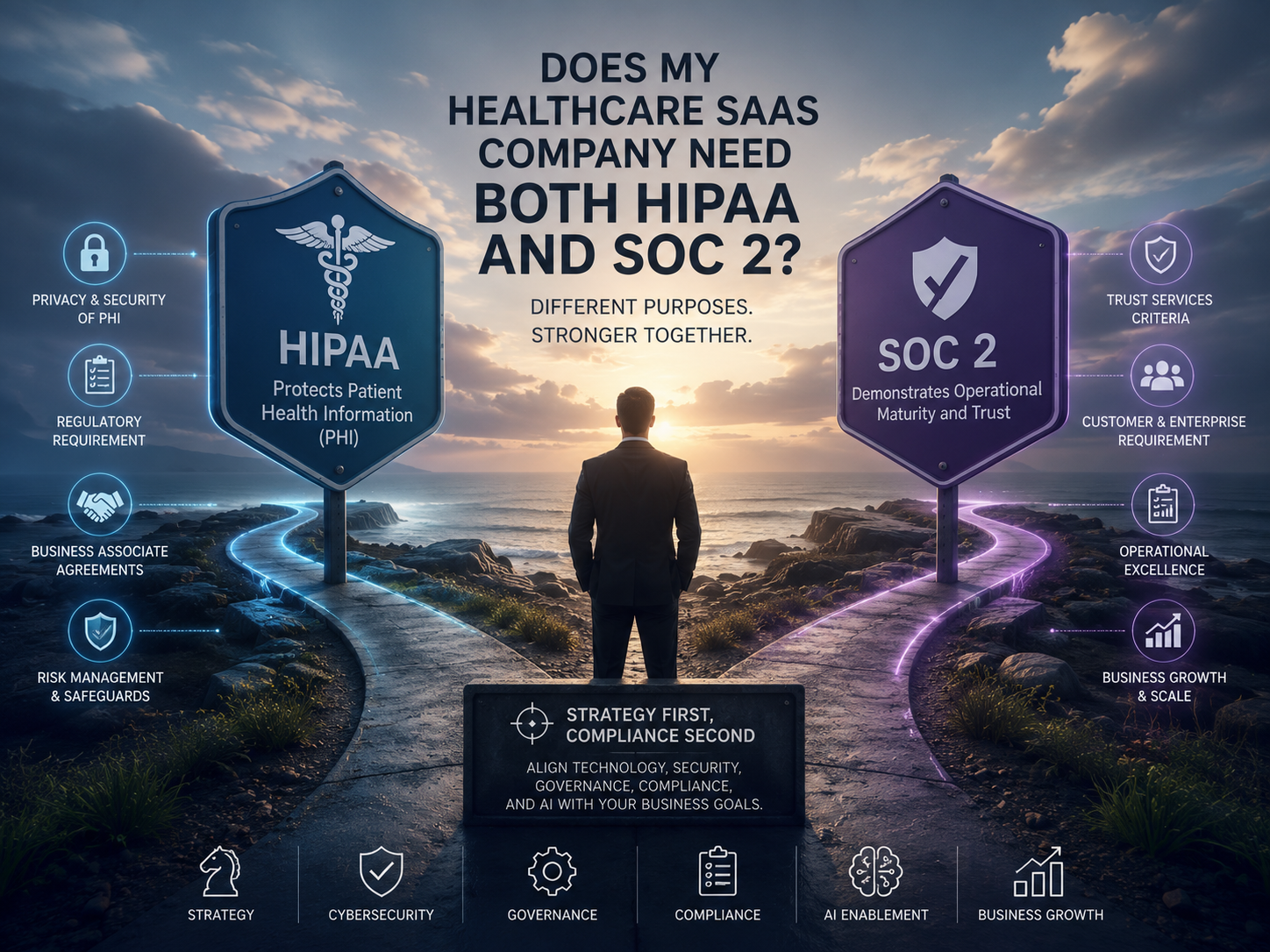
If you’re building a healthcare SaaS company, you’ve probably heard two compliance frameworks mentioned over and over again:
HIPAA and SOC 2.
It’s a common question we hear from founders, CTOs, and executive teams:
“Do we need HIPAA, SOC 2, or both?”
The answer isn’t always straightforward.
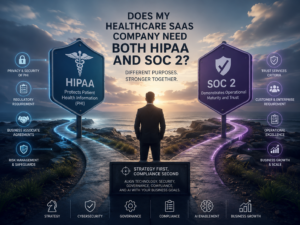
The reality is that these frameworks serve different purposes, solve different business problems, and often complement one another.
The better question isn’t:
“Which compliance framework do we need?”
It’s:
“What kind of organization are we trying to build?”
At Kraken Technology Solutions, we believe compliance should never be viewed as a checkbox exercise. Governance, cybersecurity, technology, compliance, and AI all work together to help organizations scale, earn trust, and reduce operational risk.
Let’s look at why.
What is HIPAA?
The Health Insurance Portability and Accountability Act (HIPAA) establishes requirements for protecting Protected Health Information (PHI).
If your healthcare SaaS platform stores, processes, transmits, or accesses PHI on behalf of healthcare providers, health plans, or other covered entities, HIPAA likely applies to your organization.
HIPAA focuses on protecting patient information through administrative, physical, and technical safeguards.
That includes areas such as:
- Access controls
- Encryption
- Audit logging
- Risk assessments
- Workforce training
- Incident response
- Business Associate Agreements (BAAs)
HIPAA exists to protect patient privacy.
What is SOC 2?
SOC 2 is completely different.
Developed by the American Institute of Certified Public Accountants (AICPA), SOC 2 evaluates how an organization manages customer data based on the Trust Services Criteria.
Those include:
- Security
- Availability
- Processing Integrity
- Confidentiality
- Privacy
Unlike HIPAA, SOC 2 is generally not required by law.
Instead, it’s increasingly required by customers.
Many enterprise healthcare organizations won’t even complete procurement until they know whether a software vendor has a SOC 2 report.
SOC 2 demonstrates operational maturity.
It tells customers:
“This company has implemented governance, security controls, monitoring, policies, and operational processes that have been independently evaluated.”
HIPAA and SOC 2 Solve Different Problems
One of the biggest misconceptions in healthcare technology is believing that HIPAA and SOC 2 are interchangeable.
They’re not.
HIPAA answers questions like:
- Are patient records protected?
- Are we handling PHI appropriately?
- Are we meeting federal privacy requirements?
SOC 2 answers different questions.
It demonstrates to customers that your organization has mature operational and security controls designed to protect their information and operate consistently over time.
One framework protects regulated healthcare data.
The other builds confidence in your organization’s overall governance and security practices.
Why Many Healthcare SaaS Companies Eventually Need Both
As healthcare software companies grow, they often discover that HIPAA alone isn’t enough.
Here’s a common progression:
Early Stage
A startup focuses on building a great product while implementing HIPAA safeguards.
Growth Stage
Larger healthcare customers begin asking for:
- SOC 2 reports
- Vendor risk assessments
- Security questionnaires
- Incident response documentation
- Business continuity plans
Enterprise Stage
Compliance becomes a competitive advantage.
Organizations with mature governance often move through security reviews faster because they’ve already built repeatable processes and documented controls.
Compliance stops being an obstacle.
It becomes part of the sales process.
Compliance Should Support Business Growth
This is where many organizations make a costly mistake.
They wait until a customer requires SOC 2 before starting.
Or they rush to implement HIPAA only after signing a healthcare client.
That’s reactive compliance.
Strategic organizations think differently.
They recognize that governance isn’t just about satisfying auditors.
Good governance creates:
- Better documentation
- Consistent onboarding
- Reduced operational risk
- Executive visibility
- Better cybersecurity
- Responsible AI adoption
- Greater customer trust
Those aren’t compliance outcomes.
Those are business outcomes.
Technology, Compliance, and AI Are Connected
Many organizations still treat technology, cybersecurity, compliance, and AI as separate initiatives.
They’re not.
Responsible AI depends on governed data.
Cybersecurity supports compliance.
Technology enables business strategy.
Governance connects everything together.
Organizations that understand these relationships don’t just pass audits.
They build companies that are easier to scale, easier to secure, and easier to trust.
So…Do You Need HIPAA, SOC 2, or Both?
The answer depends on your business model, customers, growth plans, and long-term objectives.
Some healthcare SaaS companies only require HIPAA.
Many eventually benefit from both HIPAA and SOC 2 as they pursue enterprise customers and larger healthcare organizations.
The important thing isn’t choosing a framework first.
It’s understanding where your business is today—and where you want it to be tomorrow.
Start With Strategy, Not Compliance
At Kraken Technology Solutions, we don’t begin with a checklist.
We begin with your business.
That’s why we developed the Kraken Strategic Technology Assessment (KSTA).
KSTA helps business leaders understand how technology, cybersecurity, governance, compliance, and AI work together to support long-term growth.
During the assessment, we help organizations identify:
- Which compliance frameworks are most relevant to their business.
- Where governance gaps may exist.
- How technology can create greater operational value.
- Opportunities to strengthen cybersecurity.
- Practical ways to prepare for AI while maintaining trust and governance.
The goal isn’t simply to pass an audit.
It’s to build an organization that’s resilient, scalable, and prepared for the future.
If you’re evaluating HIPAA, SOC 2, or simply wondering whether your technology strategy is aligned with your business goals, the Kraken Strategic Technology Assessment (KSTA) is the best place to start.
Final Thoughts
HIPAA and SOC 2 aren’t competing frameworks.
They’re tools that support different aspects of a healthy, growing healthcare technology company.
Organizations that treat compliance as a business capability—not just a regulatory requirement—often discover they’re building something much bigger than an audit trail.
They’re building trust.
And trust is one of the most valuable competitive advantages any healthcare SaaS company can have.