Every business leader has a list of decisions they’re planning to make “someday.”
Upgrade aging computers.
Implement AI.
Replace outdated software.
Improve cybersecurity.
Document critical business processes.
Develop a technology roadmap.
Most organizations don’t delay these decisions because they don’t care.
They delay because they’re busy.
The business is growing.
Revenue needs attention.
Employees need support.
Customers come first.
So technology decisions slowly move to the bottom of the list.
The problem?
Doing nothing is still making a decision.
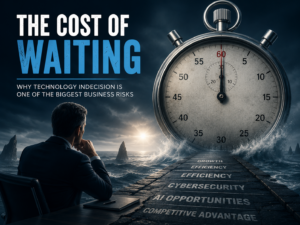
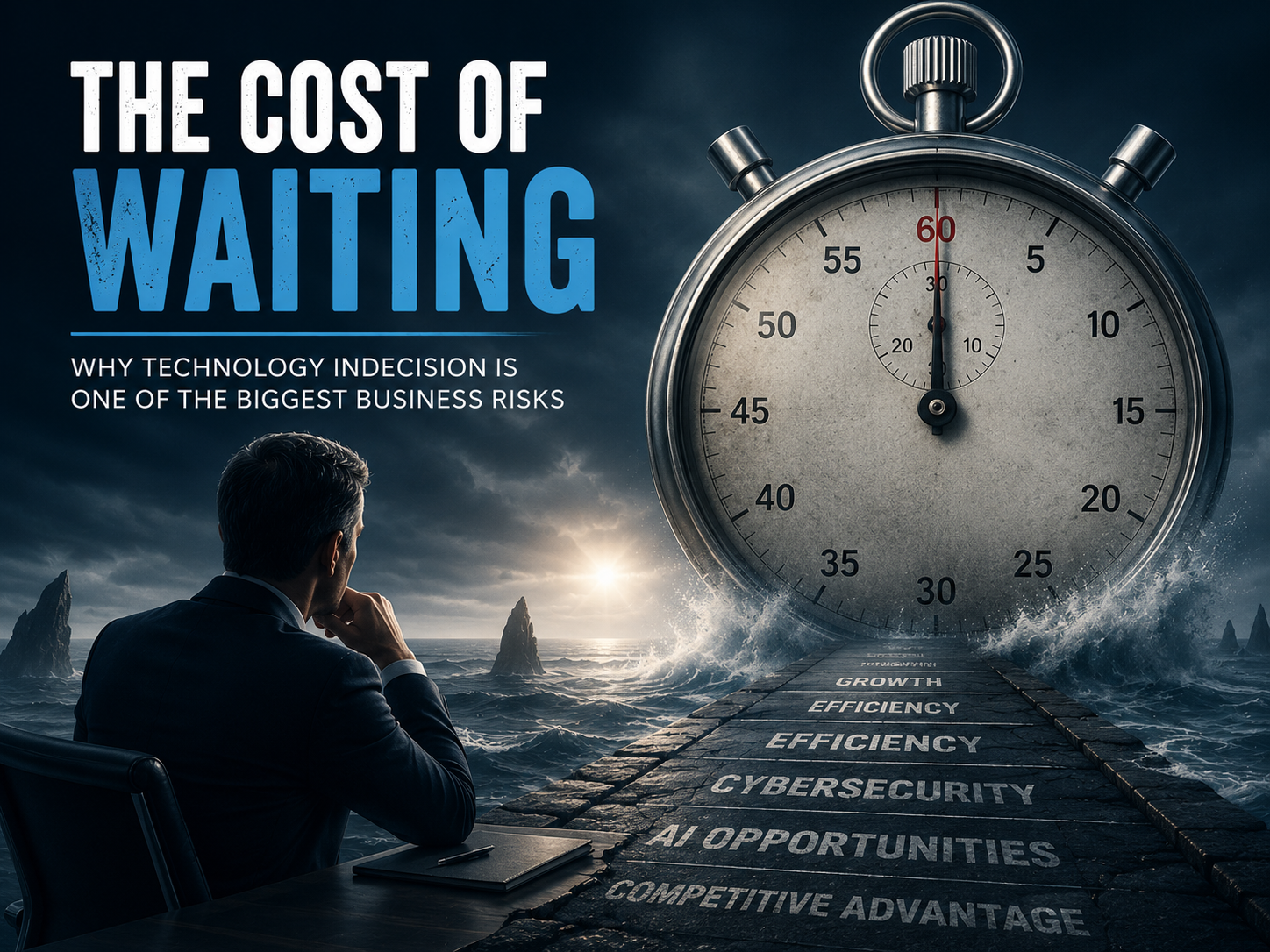
And over time, the cost of indecision quietly compounds.
The Hidden Cost of Waiting
Many executives think of technology as a project.
In reality, technology is an operating system for the business.
Every day an outdated process remains in place, employees spend unnecessary time performing manual work.
Every month an aging server remains online, cybersecurity risk increases.
Every quarter documentation goes unfinished, organizational knowledge walks out the door when employees leave.
Every year technology strategy is postponed, competitors continue improving efficiency.
None of these problems usually create an immediate crisis.
Instead, they accumulate.
Small inefficiencies become operational bottlenecks.
Minor security gaps become major vulnerabilities.
Simple process improvements become expensive transformation projects.
The greatest cost isn’t always the technology you purchase.
Sometimes it’s the technology decision you never make.
Why Leaders Delay Technology Decisions
In our experience, most executives aren’t avoiding technology because they lack vision.
They’re waiting for certainty.
They tell themselves:
“We’ll do it after our busy season.”
“Let’s wait until next year’s budget.”
“Technology changes so quickly—we should wait for the next version.”
“AI is moving so fast that it’s better to hold off.”
These thoughts are understandable.
But technology never stops evolving.
There will always be another platform.
Another software release.
Another cybersecurity threat.
Another AI announcement.
Waiting rarely creates clarity.
More often, it creates technical debt.
Technical Debt Isn’t Just an IT Problem
When people hear the phrase technical debt, they often think about software developers.
But technical debt affects every organization.
It appears as:
- Legacy systems that no longer support business growth.
- Manual processes employees have simply accepted.
- Data stored in multiple locations.
- Security practices that haven’t kept pace with current threats.
- Documentation that exists only in someone’s memory.
Over time, technical debt becomes organizational debt.
It slows decision-making.
Reduces agility.
Increases operational costs.
And makes every future improvement more difficult.
AI Is a Perfect Example
Artificial intelligence is creating enormous opportunities.
It’s also creating enormous hesitation.
Many organizations are delaying AI because they don’t know where to begin.
Ironically, waiting may be the most expensive choice.
Businesses that begin learning responsibly today will develop experience, governance, and confidence.
Organizations that postpone every AI conversation risk falling further behind—not because AI replaces them overnight, but because competitors gradually become more efficient.
The goal isn’t to implement AI everywhere.
The goal is to begin building organizational capability.
Technology Should Never Drive the Business
This is where many organizations make another mistake.
They assume the solution is simply buying new technology.
It isn’t.
Technology is rarely the starting point.
Leadership is.
Instead of asking:
“What software should we buy?”
Executives should ask:
- What business outcome are we trying to achieve?
- Where are we losing time?
- What risks concern us most?
- What capabilities do we need over the next three to five years?
- How can technology support those objectives?
Those questions almost always produce better technology decisions than evaluating products first.
Technology supports the mission.
It shouldn’t define it.
Small Decisions Compound
Every technology decision creates momentum.
Good decisions compound.
Clear documentation compounds.
Strong governance compounds.
Cybersecurity maturity compounds.
AI readiness compounds.
Intentional leadership compounds.
Unfortunately, so does indecision.
Every postponed decision makes the next one more difficult.
The organization slowly adapts to inefficiency until inefficiency feels normal.
That’s one of the greatest risks business leaders face.
Not dramatic failure.
Gradual acceptance of unnecessary friction.
Why We Created the Kraken Strategic Technology Assessment
At Kraken Technology Solutions, we’ve learned that most organizations don’t need another technology sales presentation.
They need clarity.
That’s why we created the Kraken Strategic Technology Assessment (KSTA).
The KSTA isn’t an IT assessment.
It’s an executive conversation.
Together, we evaluate your business objectives, current technology landscape, governance, cybersecurity posture, operational challenges, and future opportunities.
The goal isn’t to recommend technology for technology’s sake.
The goal is to help leadership make intentional decisions that strengthen the organization.
Because once the business objectives become clear, the technology roadmap usually follows naturally.
Leadership First. Technology Second. Outcomes Always.
Technology will continue to change.
Artificial intelligence will continue to evolve.
Cybersecurity threats will continue to adapt.
New platforms will continue to emerge.
Those things are inevitable.
The organizations that succeed over the next decade won’t necessarily be the ones with the newest technology.
They’ll be the ones whose leaders consistently make intentional decisions aligned with their mission, guided by sound principles, and focused on long-term outcomes.
Technology changes.
Principles endure.
The question isn’t whether your organization will invest in technology.
The question is whether you’ll make those decisions intentionally—or allow indecision to make them for you.
Ready to Build a Technology Strategy That Supports Your Business?
If you’re ready to move beyond reactive IT and develop a technology strategy aligned with your organization’s goals, the Kraken Strategic Technology Assessment (KSTA) is designed to help.
We’ll help you evaluate where you are today, identify opportunities, reduce risk, and build a roadmap that supports your mission—not just your infrastructure.