Stop Thinking About Technology as a Cost
Ask most business owners what technology means to their organization, and you’ll often hear answers like:
- Computers
- Servers
- Cybersecurity
- Microsoft 365
- IT Support
Those are all important.
But they’re not the reason technology exists.
Technology doesn’t create value because you purchased a firewall or migrated to the cloud. It creates value because it helps your business become more efficient, more secure, more scalable, and ultimately more valuable.
That’s the conversation too many organizations never have.
At Kraken Technology Solutions, we believe technology should never be viewed simply as an operational expense. It should be viewed as a strategic investment in your company’s future.
If your technology strategy isn’t increasing your company’s enterprise value, it’s time to ask why.
Enterprise Value Is About More Than Revenue
Many business owners believe enterprise value is determined primarily by revenue.
Revenue certainly matters.
Profitability matters.
But sophisticated buyers, investors, lenders, and executive leadership teams evaluate far more than financial statements.
They ask questions like:
- Is the company operationally mature?
- Are business processes documented?
- Can the organization scale?
- Does leadership have visibility into operations?
- Is knowledge trapped inside employees’ heads?
- How much operational risk exists?
- Is technology enabling growth or slowing it down?
The answers to those questions directly affect business valuation.
Technology is one of the most powerful tools an organization has to improve those answers.
Leadership Creates Enterprise Value. Technology Amplifies It.
One of the core principles behind Kraken Technology Solutions is simple:
Leadership creates enterprise value. Technology amplifies leadership.
Technology doesn’t make decisions.
Technology doesn’t define vision.
Technology doesn’t establish culture.
Leadership does.
The role of technology is to execute leadership’s vision faster, more consistently, and with greater visibility.
When executive teams align technology with business objectives, technology becomes a multiplier instead of a cost center.
Operational Maturity Creates Stronger Companies
One of the biggest differences between growing businesses and stagnant businesses is operational maturity.
Operational maturity means your company isn’t dependent on one person knowing how everything works.
Instead, your organization develops:
- Documented processes
- Standard operating procedures
- Centralized information
- Repeatable workflows
- Clear accountability
- Executive visibility
- Consistent decision-making
Technology enables all of those things.
Microsoft 365, SharePoint, Power Platform, dashboards, automation, AI, and collaboration tools are valuable because they improve how the business operates—not because they are new technology.
The technology itself isn’t the competitive advantage.
The operational maturity it creates is.
Cybersecurity Protects Enterprise Value
Cybersecurity is often viewed as insurance.
While protection is important, cybersecurity serves a much larger purpose.
It protects the very assets that create enterprise value.
Including:
- Customer trust
- Intellectual property
- Financial information
- Operational continuity
- Business reputation
- Employee productivity
A single ransomware event can damage years of business growth.
Cybersecurity isn’t simply an IT function.
It’s a business continuity strategy.
Organizations that understand this build cybersecurity into leadership discussions instead of treating it as an annual IT purchase.
Compliance Demonstrates Organizational Excellence
Compliance is often misunderstood.
Many organizations see compliance as something they are forced to do because of regulations.
We believe that’s the wrong perspective.
Frameworks like:
- CIS Controls
- HIPAA
- CMMC
- FTC Safeguards Rule
- NIST Cybersecurity Framework
all encourage organizations to improve governance, documentation, accountability, and operational discipline.
Those same characteristics make organizations stronger.
Customers trust compliant businesses.
Banks trust compliant businesses.
Insurance companies trust compliant businesses.
Potential buyers trust compliant businesses.
Compliance isn’t simply about passing an audit.
It’s about demonstrating operational excellence.
AI Is Only As Good As Your Company’s Knowledge
Artificial Intelligence is changing business faster than almost any technology we’ve seen.
But AI cannot create knowledge that doesn’t exist.
Organizations with poor documentation, inconsistent processes, and scattered information will struggle to realize meaningful AI value.
Organizations with strong governance, centralized documentation, and well-managed knowledge will gain a tremendous competitive advantage.
That’s why we often say:
AI is not the product. Your knowledge is the product.
Technology simply provides a better way to use it.
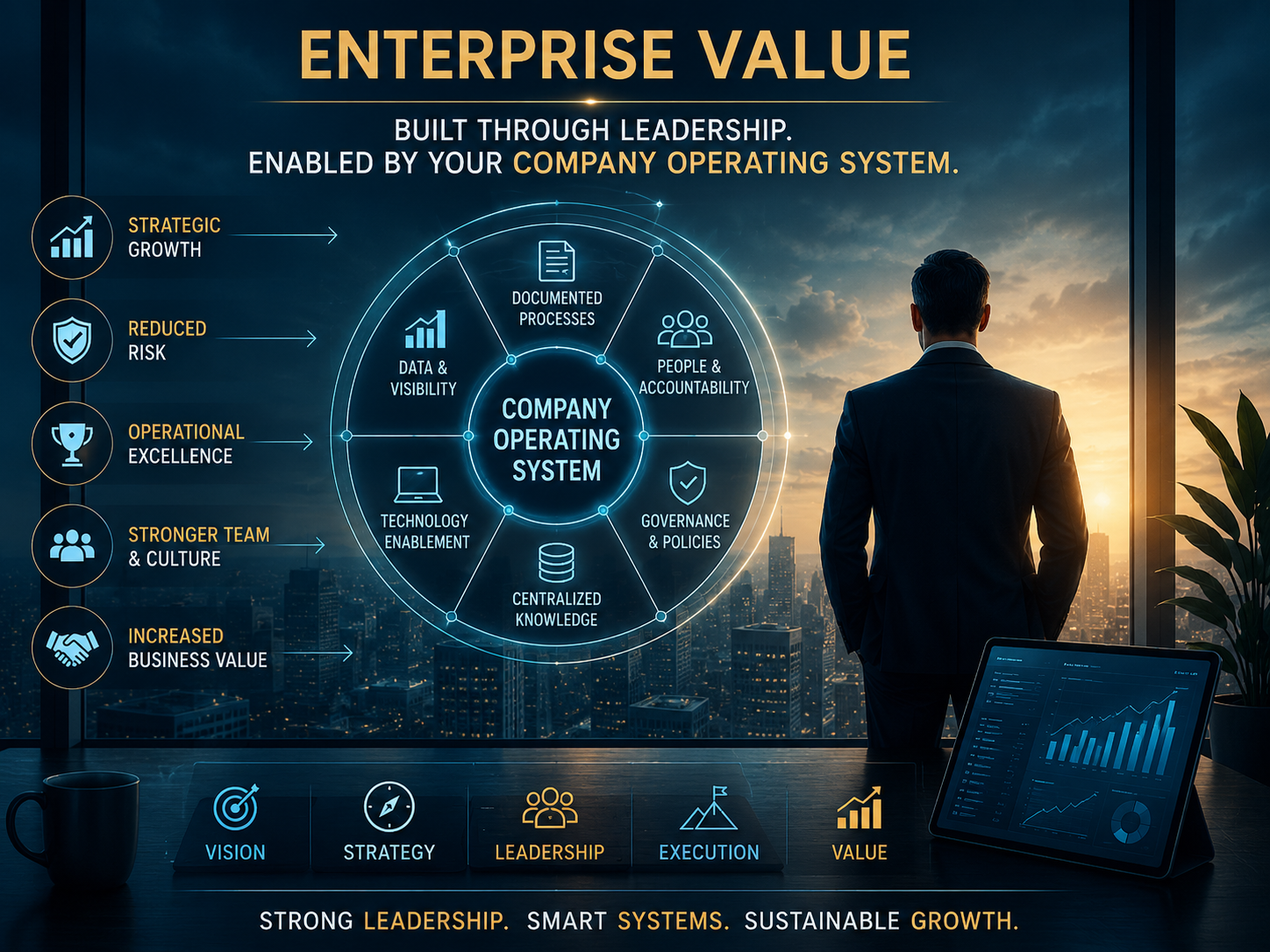
Every Growing Business Needs a Company Operating System
One of the concepts we’re most passionate about is helping organizations build what we call a Company Operating System.
A Company Operating System isn’t software.
It’s the documented framework that defines how your business operates.
It includes:
- Standard operating procedures
- Organizational knowledge
- Policies
- Governance
- Business documentation
- Technology standards
- Leadership principles
- Department processes
- Decision frameworks
- AI-ready knowledge
Think of it as the institutional memory of your business.
Instead of knowledge walking out the door when employees leave, your Company Operating System preserves it.
That increases consistency.
It improves onboarding.
It supports growth.
It strengthens leadership.
And ultimately, it increases enterprise value.
Technology Leadership Is About Business Leadership
Traditional IT conversations often begin with questions like:
- How many users do you have?
- What firewall are you using?
- Who hosts your email?
- Where are your files stored?
Those questions matter.
But they aren’t where executive conversations should begin.
Technology leadership begins with different questions.
Where is your business headed?
What goals are you trying to accomplish?
What’s slowing growth?
Where does operational risk exist?
What information does leadership wish they had today?
Technology should always support the mission of the organization—not become the mission itself.
Why We Start With a Strategic Assessment
This philosophy is the reason we developed the Kraken Strategic Technology Assessment (KSTA).
We don’t begin relationships by recommending products.
We begin by understanding the business.
Because before technology can create enterprise value, leadership needs clarity.
The KSTA evaluates:
- Technology
- Cybersecurity
- Operational maturity
- Governance
- Documentation
- Business processes
- AI readiness
- Strategic alignment
- Leadership objectives
Only then can meaningful recommendations be made.
Technology should never be implemented simply because it’s available.
It should be implemented because it moves the business closer to its goals.
Final Thoughts
The organizations that will thrive over the next decade won’t necessarily be the ones with the biggest technology budgets.
They’ll be the organizations with the strongest leadership, the clearest strategy, and the highest level of operational maturity.
Technology is simply the force multiplier.
At Kraken Technology Solutions, we believe technology should help organizations:
- Increase enterprise value.
- Improve operational maturity.
- Reduce business risk.
- Strengthen leadership.
- Enable sustainable growth.
Because technology isn’t the goal.
Building a stronger business is.