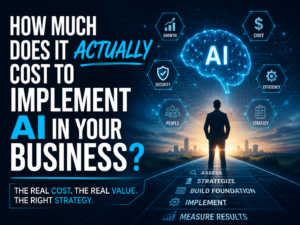
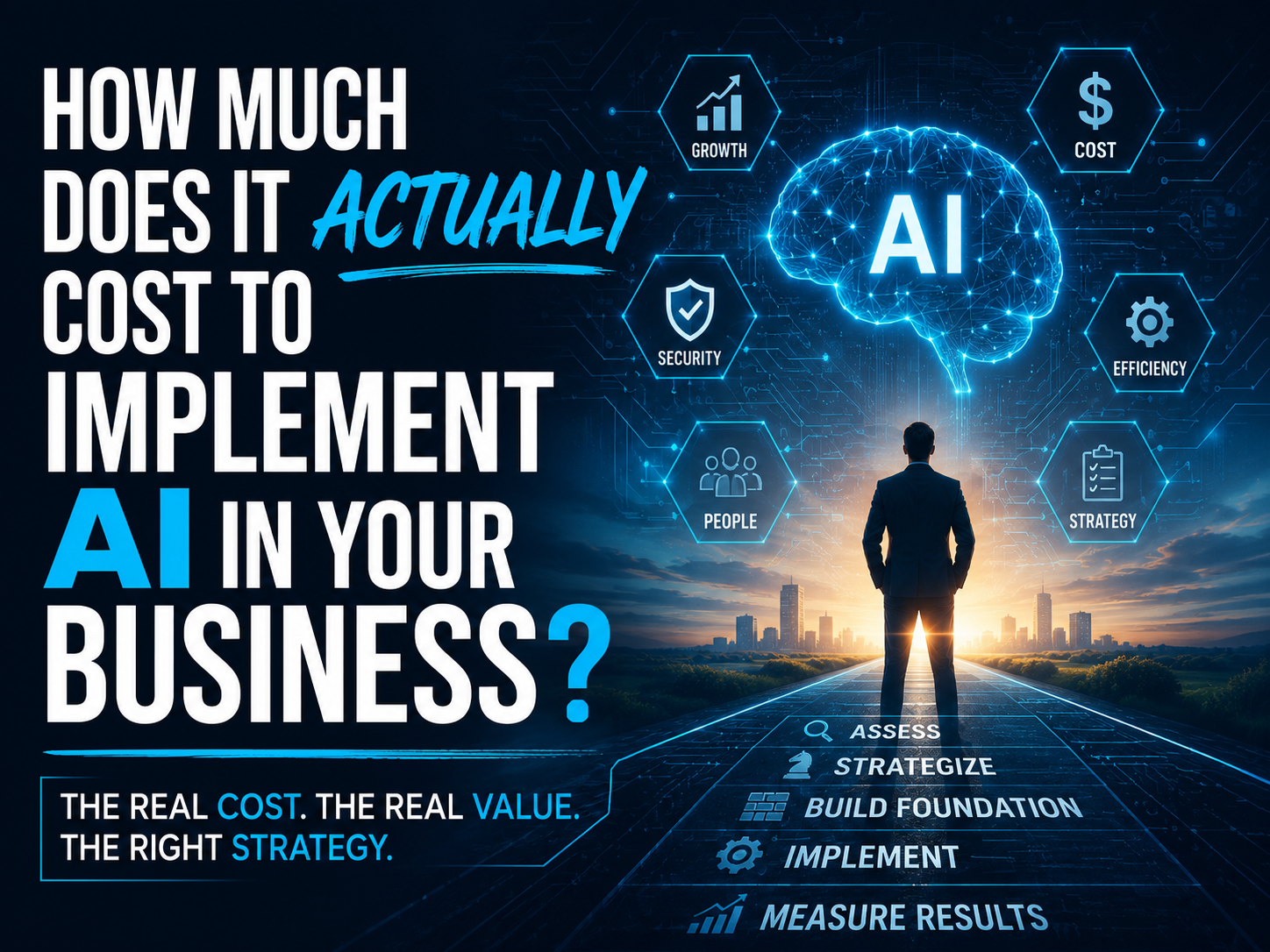
The Real Cost Isn’t the Software—It’s Whether Your Business Is Ready to Benefit From It.
Artificial Intelligence is everywhere.
Microsoft Copilot.
ChatGPT.
Claude.
Gemini.
Countless industry-specific AI platforms.
Business owners are constantly asking us:
“How much does AI cost?”
It’s a fair question.
But it’s also the wrong place to start.
At Kraken Technology Solutions, we believe AI isn’t a software purchase.
It’s a business capability.
And the organizations that realize the greatest return on AI aren’t necessarily the ones spending the most money—they’re the ones that prepared their business first.
The Software Is Usually the Least Expensive Part
Many executives expect AI projects to look like traditional software purchases.
Buy licenses.
Install software.
Train employees.
Done.
Unfortunately, that’s rarely how successful AI implementations work.
The monthly subscription is often one of the smallest parts of the investment.
The larger investment is preparing your business to actually use AI effectively.
Questions like:
- Is your data organized?
- Is your documentation current?
- Are permissions properly governed?
- Are employees using consistent processes?
- Can AI safely access the information it needs?
- Are there policies governing AI usage?
- Is your institutional knowledge documented—or does it live only inside key employees’ heads?
Those questions have a much bigger impact on ROI than whether Copilot costs $30 per user.
The Hidden Costs Most Businesses Never Consider
Organizations frequently underestimate the work required before AI can deliver meaningful value.
These hidden costs often include:
Documenting Business Processes
AI cannot assist with processes that haven’t been documented.
If every employee performs work differently, AI simply learns inconsistency.
Organizing Institutional Knowledge
Policies.
Procedures.
Client information.
Operational knowledge.
If information is scattered across email, file shares, SharePoint, personal OneDrive folders, sticky notes, and employees’ memories…
AI has nothing reliable to work from.
Governance and Security
One of the biggest risks we see today is Shadow AI.
Employees are already using ChatGPT, Claude, and other AI platforms without organizational oversight.
That creates risks around:
- Confidential information
- Customer data
- Intellectual property
- Regulatory compliance
- Inconsistent business decisions
Before deploying AI, organizations need governance—not just licenses.
This Is Why Every AI Conversation Should Begin With Strategy
Rather than immediately recommending software, we begin with a Kraken Strategic Technology Assessment (KSTA).
The KSTA helps leadership answer questions like:
- Where are we today?
- What business goals are we trying to achieve?
- Which processes create the most friction?
- What technology investments already exist?
- Where can AI provide measurable business value?
- What risks need to be addressed first?
Only after understanding the business do we begin discussing AI platforms.
AI Doesn’t Replace Good Business Operations
One of the biggest misconceptions surrounding AI is that it somehow fixes disorganized businesses.
It doesn’t.
AI accelerates whatever already exists.
If your organization has:
- Strong governance
- Documented processes
- Organized knowledge
- Secure systems
- Executive visibility
AI becomes an incredible force multiplier.
If those things don’t exist…
AI simply helps create confusion faster.
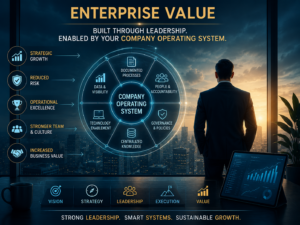
Building the Foundation: The Kraken Operating System (KOS)
After understanding the business, our focus shifts to building an operational foundation.
The Kraken Operating System (KOS) creates a centralized, governed environment where organizational knowledge becomes usable—not just for employees, but eventually for AI as well.
Instead of information living in disconnected systems, KOS organizes:
- Business processes
- Department knowledge
- Policies
- Standard operating procedures
- Forms
- Dashboards
- Applications
- Automation
- Governance
The result is a business that becomes increasingly searchable, measurable, scalable, and AI-ready.
Measuring AI ROI
The real return on AI isn’t measured by how many prompts employees write.
It’s measured by outcomes.
For example:
- Faster employee onboarding
- Reduced administrative work
- Better executive visibility
- Improved decision making
- Reduced operational risk
- Higher employee productivity
- Better customer experience
- More consistent business processes
Those are business outcomes—not technology metrics.
AI Is a Business Investment
Technology alone has never created business value.
Businesses create value when technology supports people, processes, governance, and strategic goals.
That’s why we don’t begin AI engagements by asking:
“Which AI tool do you want?”
We begin by asking:
“Where is your business trying to go, and how can technology help you get there?”
When organizations answer that question first, AI becomes much more than another software subscription.
It becomes a strategic advantage.
Ready to Build an AI-Ready Business?
If you’re considering AI but aren’t sure where to begin, start with a Kraken Strategic Technology Assessment (KSTA).
We’ll help you evaluate your current technology, identify opportunities for AI, assess governance and security, and build a roadmap that aligns technology investments with your business goals—so every future investment delivers measurable value.